Why Is Xi Jinping Repressing China Again
Repression in 11's China
Repression in Xi'south Cathay
The tightening of state control over Hong Kong and Xinjiang reveal a consolidation of authorisation in Xi's CCP, intent on stifling any signs of nonconformity.
Hong Kong in Defection: The Protest Move and the Time to come of China
past Au Loong-Yu
Pluto Press, 2020, 224 pp.
The War on the Uyghurs: Communist china's Internal Campaign against a Muslim Minority
by Sean R. Roberts
Princeton University Printing, 2020, 328 pp.
In Hong Kong in Revolt, labor organizer Au Loong-Yu analyzes the protests that rocked the metropolis in 2019. The participants were pushing back against the politically motivated disqualification of pro-democracy legislators, the imprisonment of nonviolent activists on trumped-up charges, and other oppressive moves by the Hong Kong authorities, who represent local moneyed interests and take their cues from Beijing leaders who increasingly act like heads of an empire. Au sees both anti-backer and anti-colonial dimensions to the 2022 protests, although he argues that activists should accept been less focused on what sets Hong Kong residents apart from those living in mainland urban centers and more than interested in using shared working-class grievances equally a basis for building border-spanning solidarity.
The State of war on the Uyghurs, by anthropologist Sean R. Roberts, who directs the International Development Studies Plan at George Washington University, focuses on repression rather than resistance. Roberts makes a compelling case for seeing the Chinese Communist Political party's actions in Xinjiang, where many members of the largely Muslim local population are at present detained in camps, as constituting a horrific crime confronting humanity.
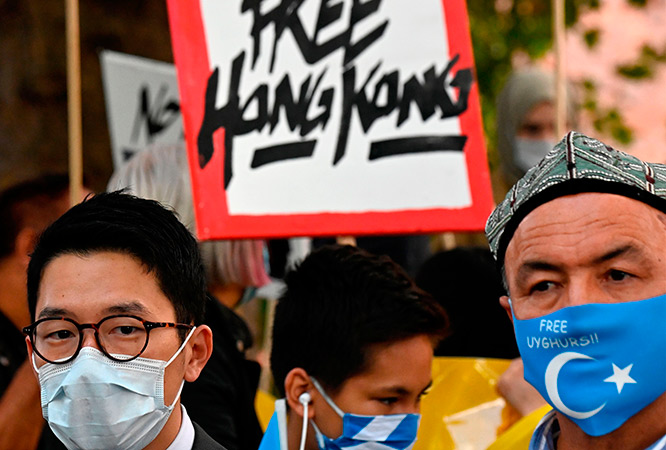
Read together, these books show how the political conditions in Hong Kong and Xinjiang, ofttimes treated separately, are linked.
The 2022 pro-democracy Umbrella Movement in Hong Kong was the biggest sustained social motion to accept identify in any part of the People's Democracy of Mainland china since the Tiananmen upheaval of 1989. Last year'due south protest wave lasted even longer, involved more than people, and saw both more protester militancy and more than police brutality. Most participants in the 2022 struggle—which began as a fight to block an extradition pecker that would undermine the rule of law in the city but expanded to a broader fight to protect local freedoms—stuck to irenic tactics. Some activists defaced property and hurled Molotov cocktails and bricks, just much more than violence came in the other direction. There was no 1989-style massacre, only over 10,000 demonstrators were arrested in 2022 and 2020. The call to investigate the police became a key protest demand. There was widespread alert at the injuries suffered by protesters, journalists, and bystanders, and anger about how much tear gas the police deployed, including in indoor spaces like shopping malls. Around a million people marched in Hong Kong on June 9, 2019, and past some estimates 2 million came out the following week.
In Xinjiang, by dissimilarity, at least a million people have disappeared into a vast network of extrajudicial facilities. The astounding telescopic of these detention camps has been documented by NGO workers, journalists, think tank researchers, and scholars using satellite images, interviews with Uyghurs and Kazakhs, and government documents that detail construction plans and the hiring of guards. The CCP initially denied there were camps, then insisted they were benign sites for vocational training. Higher up all, they presented population relocations in Xinjiang every bit efforts to rid the region of those with extremist views, even though university administrators, anthropologists, poets, and highly trained professionals with no history of expressing radical views have been amid those interned.
Those held in these gulags are overwhelmingly Muslim Uyghurs. Roberts describes this as a campaign of "cultural genocide." The goal seems to exist to eliminate Uyghurs equally a distinctive indigenous population. There have been reports of forced sterilizations of Uyghur women, destruction of Uyghur shrines and graveyards, limits on the use of the Uyghur linguistic communication, forced labor programs, and the removal of Uyghur children to guarded "schools" far away from their parents.
Hong Kong and Xinjiang are strikingly unlike settings. Xinjiang, in the northwestern corner of the China, is a massive barren territory more than twice the size of Texas. Hong Kong is in the southeast, rainy, and less than half the size of Rhode Island. Ane of Xinjiang's urban centers is further from an ocean than any other city in the world, while Hong Kong is made up largely of ports and islands. Xinjiang has few people per square mile, while Hong Kong is densely populated. Many of Xinjiang's residents speak Turkic languages and belong to Turkic ethnic groups—not just the Uyghurs but also Kazakhs, Kyrgyz, Tatars, and Uzbeks. In Hong Kong, there are locals who experience at home in a diversity of languages, including English, and have forebears from places ranging from Bombay to Manchester, merely the majority of the populace are Cantonese speakers of Chinese descent.
Hong Kong was too distinctive for its relative political autonomy. When Hong Kong became a Special Administrative Region of the PRC in 1997, locals were promised that, compared to whatever mainland city, their printing would be freer, it would be easier to hold protests, and courts would exist more independent. They were also promised that there would be free elections for many seats in the local legislature, though some would be gear up aside for candidates likely to serve Beijing's interests, and that eventually they would exist able to choose the most powerful official in the metropolis, the chief executive. From the get-go Beijing and its local proxies have been undermining these promises and working to limit the freedoms that Hong Kong's people enjoyed. Particularly during the first decade after the Handover, however, Hong Kong was by far the almost autonomous part of the Mainland china.
Despite these differences, the Prc has tightened control over both Hong Kong and Xinjiang in recent years, reflecting the CCP's aim, particularly since Xi Jinping became general secretary in 2012, of cultural homogenization. The methods used confronting those who challenge this vision vary from region to region, only in Xi'due south People's republic of china all forms of cultural divergence are suspect. The camp system in Xinjiang is extrajudicial. In Hong Kong, by contrast, those taken off the streets have more often than not been able to consult with lawyers and accept their day in court—although not e'er, as with the twelve people from Hong Kong who were seized while trying to escape to Taiwan and are at present being held incommunicado in Shenzhen. In Xinjiang, authorities interpret beards as a sign of religiosity and evidence of radicalization and potential terrorist inclinations, while singing a banned song, or simply being a youth on the streets wearing black (the favored clothing of young militants during the 2022 protests), can get you into trouble in Hong Kong. These efforts to stifle even small signs of nonconformity reflect a new consolidation of authority under 11'south CCP.
The War on the Uyghurs is an bookish book; Roberts makes it articulate that he hopes information technology volition aid efforts to raise awareness about an appalling situation, but information technology is presented equally part of a debate amidst scholars. Roberts did fieldwork in Xinjiang early in his career simply has been blocked from going to the Mainland china for decades. His analysis is based on close readings of documents and extended interviews with former residents of Xinjiang who now live outside of it.
Au writes in a more unapologetically activist vein, with a lively but occasionally hectoring style. He is less interested in the overall bookish and popular literature on Hong Kong, and the arguments showcased in his book are not those between researchers but between rival wings of the resistance. Au, who is based in Hong Kong, peppers his assay with observations of protests he attended and conversations he had on the streets. He also slips in some optimistic comments, which I do not find completely convincing, most how the pandemic and other contempo events accept "exposed the internal weakness" of the "mighty political party-state" headed by 11, opening upwards possibilities for futurity efforts to resist. (He finished his book before some contempo and disturbing Hong Kong developments, including a new round of moves against pro-republic legislators, initiated in Beijing and implemented in ways that circumvented local courts, that have effectively transformed the Legislative Council into a condom-stamp body.)
One matter that makes these books particularly useful is how they tin assist dispel the lingering unease among some on the left near forthrightly considering repression in Hong Kong and Xinjiang—an unease generated in function by how enthusiastically some on the right have taken up the causes of the victims of CCP repression.
A pocket-sized number of Hong Kong activists waved British and American flags at 2022 rallies, in some cases merely to twist the tail of the CCP and its local proxies. These actions struck some on the left every bit politically suspect, with the Union Jack seeming to suggest nostalgia for British colonial rule and the Stars and Stripes implying support for the U.S. government. In that location are a pocket-sized number of supporters of the Hong Kong movement who have expressed the thought that things were better under rule past the United kingdom, and in that location was a disturbing uptick in pro-Trump comments in Hong Kong activist circles effectually the fourth dimension of the 2022 U.S. election—a complex miracle to which the circulation of misinformation and sensationalistic conspiracy theories was ane contributing cistron. The fact that Marco Rubio and other Republican Party ideologues accept been loftier-profile supporters of Hong Kong protesters and campaigners confronting the Xinjiang camps, along with some lingering romanticization of the Prc on the left, has further dingy the waters.
Hong Kong in Revolt at times makes it seem like a struggle involving people who embrace a broad range of positions tin can be divided into i with simply a left and correct faction. But given the widespread impression that the protesters are a unified bloc, information technology is useful to hear Au has so much to say near the divergence between Hong Kong activists with a positive view of the U.Due south. right, due to its anticommunism, and activists who, like him, have a negative view of it, due to its record on labor issues and race. Finished at a fourth dimension when there were some in Hong Kong activist circles unwilling to cover solidarity with the Black Lives Matter struggle, Hong Kong in Revolt ends with a rhetorical question: "how can nosotros non support the solidarity protestation with George Floyd when nosotros Hong Kongers have just been oppressed by the same kind of police state last twelvemonth?"
Many within the Western left have spoken out in favor of the Hong Kong protesters and helped raise the alarm about the Xinjiang camps, though in some cases a flake belatedly. Dissent and the Nation have both covered the Hong Kong and Xinjiang situations in ways that align with how these books present them. A group of left intellectuals recently issued a letter decrying the persecution of the Uyghurs.
Roberts'south and Au'due south books help buttress this trend past framing events in ways that diverge sharply from sometime-style anticommunist depictions of oppression in Hong Kong and Xinjiang. Roberts stresses that American policies in the wake of 9/11—especially an approach to Islam that downplays differences between followers of the religion and supporters of terrorism—provided cover for Beijing's shift toward a harder line in Xinjiang, and was i gene that over the long run helped lay the groundwork for the development of the military camp arrangement. Au, meanwhile, rejects the thought that the Hong Kong struggle is an effort to protect a "capitalist" urban center from "Communist" encroachment. He sees the enemies of the motility as existence CCP colonialism and CCP commercialism.
In their informative coverage of Hong Kong and Xinjiang, Roberts and Au aid us appreciate the political threads that connect these places. Their books underscore the indicate that just because the CCP is disliked by many on the right does not mean we should minimize our outrage at the indefensible deportment it has taken.
Jeffrey Wasserstrom is Chancellor's Professor of History at the University of California, Irvine, and writer of Vigil: Hong Kong on the Brink (Columbia Global Reports, 2020).
adkinswithems1988.blogspot.com
Source: https://www.dissentmagazine.org/article/repression-in-xis-china
0 Response to "Why Is Xi Jinping Repressing China Again"
Post a Comment